
Entry 02
How labs track reagent expiry: What the date on the bottle misses
In the labs I've worked in, there's normally an Excel sheet. It's good for things that don't change, like the labelled expiry date, but that date is usually for an unopened bottle. Once it's opened, the lab's own experience of the reagent often matters more, and if a reagent has been contaminated, its expiry date is irrelevant.
Clear out a lab freezer and you will often find reagents with the initials of people who have left, and when they left, the history of those reagents went with them. When an antibody doesn’t show up on a western blot, it can often be down to age and too many freeze-thaw cycles. And when a reagent runs out mid-experiment, it’s usually because protocols rarely go exactly to plan: gels get redone, stocks recultured and transfections repeated, all using more than the protocol allowed for, which is quite normal.
This note looks at why that happens, what the research says, and a few things a lab can do about it. It is written for anyone new to wet labs, or anyone who has faced issues with reagent expiry tracking.
What does the lab spreadsheet actually tell you?
In the labs that I’ve worked in, there’s normally an Excel sheet. It’s good for things that don’t change much, such as the labelled expiry date and whose bottle it is. Ownership mattered most for things like cell culture solutions, where everyone in the lab usually had their own.
The sheet is useful for the basics, like whether something is even in the lab. But that only holds if someone keeps it up to date, so it’s mostly good on paper.
| Reagent | Expiry on label | Owner | Date opened | Quantity left |
|---|---|---|---|---|
| Minimum Essential Medium (MEM) | 03/2027 | AM | ? | |
| Anti-GAPDH antibody | 11/2026 | Shared | 02/2026 | ? |
| Trypsin-EDTA | 06/2027 | Shared | ? |
What the sheet usually looks like. Values are made up; the blanks and question marks are the point.
Why does the sheet fall behind?
Oftentimes, it relies on people having to update things. In the labs I’ve worked in, the inventory was passive: it only changed when someone remembered to change it. In quite a few labs it requires manual updating, even when protocols are executed. And when stocks are low, a “low” mark doesn’t tell you whether there is enough left for next week’s experiment.
A very big thing is that when a lot of people are working in a lab, they may share reagents. There may be, for instance, a litre of a certain reagent, but next week someone needs to use 800 ml of it, and in that time other people are using it as well, so it is going to run out. So the lab has to coordinate, and plan each project around what will still be there when it is needed, not just what is on the shelf today. And as at the start, redone experiments use more than was planned.
Which date actually matters?
For many reagents, the expiry on the label is for an unopened bottle stored as directed, so the date it was opened matters too.
Sometimes you can have certain reagents where the expiry date itself degrades. For instance, imagine the expiry is in 1 month. Opening it, changing it or refreezing it once, whatever the change is, may put it down to 3 weeks. But then doing that again may put it down to 2.5 weeks. How much it drops, if at all, depends on the reagent and how it is stored.
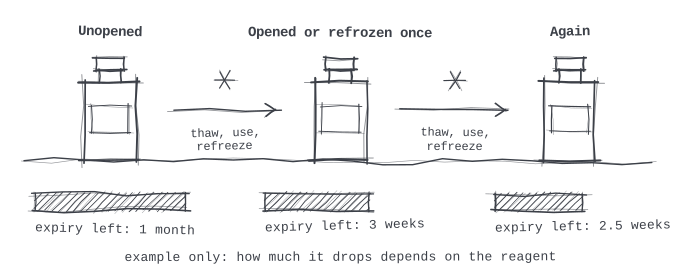
A degrading expiry date. Illustrative, not measured.
For instance, things like antibodies[1] and frozen bacteria stocks[2] depend a lot on how many times they’ve been refrozen. And after a certain amount of time, the quality goes down as well.
The lab’s experience often overtakes what the actual expiry date is. In the labs I’ve worked in, there were clear good-to-knows about the reagents we were using. With things like antibodies or solutions, we often worked to a much earlier date than the label, because our own results showed they stopped working as well before then. That is evidence from the lab’s own work and conditions, and for us it was often more useful than the manufacturer’s date.
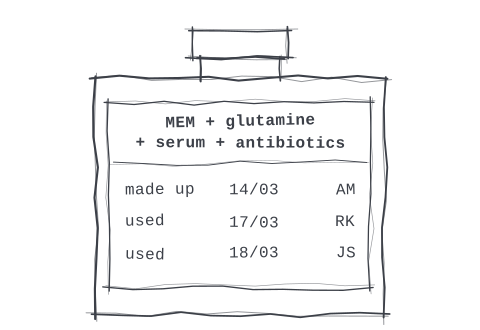
Typically, antibiotics were added to MEM mainly to keep down contamination. Glutamine and serum were quite standard as well. The antibiotics didn’t guarantee a culture was free of contamination, though. As to how that changed the date, for me personally, it almost always got used up before it became an issue. However, I would often notice contamination towards the end of a bottle. Although a lot of the time this can come from human error, whether the contamination came from that session, or whether my reagents were contaminated from a previous mistake, was hard to identify.
What happens when a shared bottle is contaminated?
Where this may become a bigger issue, and what we don’t often see, is when, for instance, a cell has been cultured and contamination was found in it. A lot of the time there’s a chance that the reagents used may have that contamination. Even though lab notebooks or reporting can record those, in the labs I’ve worked in there was no easy way to see which reagents might be contaminated. And if a reagent has been contaminated, its expiry date is completely irrelevant, leading to more failed experiments.
Although MEM has its pH indicator, which can provide warnings for contamination through its pH, turning yellowish when it goes acidic, it’s often too late. Contamination can affect an experiment before it changes the colour at all[3].
Mycoplasma is one example. In its early stages it usually doesn’t change the medium’s pH, but it can still change how cells grow and behave[3].
The issue becomes bigger when the bottles are shared[4]. Although it is efficient, this means that the contamination no longer just affects one experiment, but possibly every experiment that used that bottle. Often, pinpointing it to a certain reagent is more effort than it should require. Tracing the bottles a culture used gives you somewhere to start; it doesn’t prove which one was responsible.
| Contaminated culture | Reagents used | Who else used them that week |
|---|---|---|
| HEK293, flask 3 | MEM (AM), trypsin (shared), PBS (shared) | RK, JS |
The link the sheet did not record. Values are made up.
A checklist for the fridge door
- The lab’s own use-within date next to the supplier’s date, used first when past experiments back it up.
- A thaw tally on each antibody and bacteria stock tube or aliquot.
- Separate aliquots, so one contamination doesn’t spoil the whole stock[4].
- In weekly meetings, check next week’s planned use, so experiments don’t collide over the same bottle.
- A minimum stock level for each reagent, set so there is time to reorder before it runs out.
- Date opened on the label.
- On supplemented media, write what was added, when and by whom.
- When a culture is contaminated, check every bottle it touched and tell the owners.
- Routine mycoplasma testing[4].
What should tracking do instead?
Tracking should connect lab notes, inventory and the results of the protocols, so you can see a reagent’s history, including whether it was used in a culture that was later contaminated.
Some of that history, such as when a bottle was opened, how many times it was thawed and who else used it, may already be in someone’s notebook, a protocol or the results of a failed run. But it only reaches the inventory if someone remembers to copy it across. That one manual step is a single point of failure: miss it once and the sheet falls behind.
I think software should bring together what is already recorded in the lab notes, the inventory and the results of each protocol, without waiting for someone to type it all in again, so the lab’s own experience of a reagent sits next to the date on the bottle.
An expiry date only tells part of the story. The rest is the lab’s own experience of the reagent, and it matters as much. That is one of the problems we are building Vantaria Labs around.
Sources
- Product storage. Developmental Studies Hybridoma Bank, University of Iowa, date unknown. dshb.biology.uiowa.edu/product-storageChecked
- Protocol: how to create a bacterial glycerol stock. Addgene, date unknown. www.addgene.org/protocols/create-glycerol-stock/Checked
- Mycoplasma. UNC Lineberger Comprehensive Cancer Center, Tissue Culture Facility, . unclineberger.org/tissueculture/contaminant/mycoplasmacontam/Checked
- Geraghty RJ, Capes-Davis A, Davis JM, et al. Guidelines for the use of cell lines in biomedical research. British Journal of Cancer 111(6):1021-1046, . doi.org/10.1038/bjc.2014.166Checked
Change log
- Published.
Related notes
Vantaria is in early access, and we are working with a small number of labs as we build it. If yours would like to be one of them, request a demo.