
Entry 03
What it costs when a lab can't find its own work
A repeated experiment is paid for in full a second time. When it happens because the earlier result, method or reason for failure cannot be found, the cost never appears anywhere, because research spending is booked the day it is spent and lost knowledge is never written off. Count last quarter's repeats, price them, and ask which were avoidable.
A few months ago I sat in on a diligence call where a biotech was walking an investor through its lead data. One slide carried the result the whole story rested on. Someone asked the ordinary question: can we see the raw data, and the conditions it was run under?
Three weeks later they had an answer, and only because the company had re-run the experiment so that it had something it could stand behind. The scientist who ran the original had left, the files were on a shared drive under a name nobody recognised, the notebook had the result but not the conditions, and the one person who might have remembered was now in a different time zone.
Three weeks, a repeat nobody had budgeted for, and an investor who now had a question about the rest of the data too. None of it shows up anywhere as a cost. The budget line says what budget lines always say: research was done.
This note is for the people who pay for weeks like that: biotech founders, heads of research, CRO operations leads and PIs with a grant to answer for. It is about why that cost never appears anywhere, how big the research suggests it is, and how to put a number on your own.
Why does a repeated experiment never show up as a cost?
Because of an accounting rule, and a fairly sensible one. In company accounts, money spent on research is an expense on the day it is spent. It is never recorded as an asset[1]. Development costs can be, once a company can show the project is feasible and likely to pay off, but research cannot.
Nobody wants a balance sheet full of hopeful experiments. The side effect is that everything a lab has learned, every result, every method that worked and every one that did not, is worth nothing in the accounts. When some of it goes missing, nothing is written off; the repeat looks like new work, and the first attempt looks like it never happened.
Research spend gets reviewed every quarter, while research knowledge gets reviewed when somebody cannot find it.
What happens to a result once the experiment is over?
It starts to disappear, not dramatically and not because anyone is careless. A result lives in a few files, a notebook and one person’s memory, and all three have a shelf life.
The clearest measurement comes from a group that asked the authors of 516 papers, published between 2 and 22 years earlier, for the data behind them. The finding is tidy enough to draw: the odds that a dataset still existed fell by 17 percent for every year since publication[2]. The usual obstacles were email addresses that no longer worked and storage nobody could read any more. These were ecology papers, but a dead hard drive does not care what field it came from.
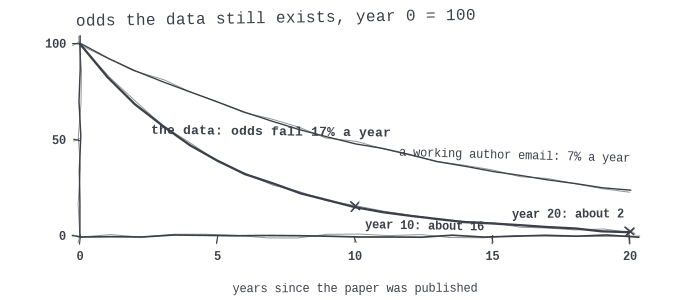
The odds that a paper’s data still exists, by years since publication. Drawn from the decline reported in[2]. Ecology papers; your lab’s results may go faster or slower.
Asking politely helps less than you would hope. When another group requested data from the authors of 875 papers in two of the best-known journals, fewer than four requests in ten produced it, and the two commonest reasons for saying no were that there was no time to look, and that the data was lost[3].
Those are published results, with a journal behind them. The result on your lab’s shared drive has neither, and nobody has measured how fast it goes.
Why can’t you just re-run it from the record?
Because the record rarely holds what a re-run needs. The result itself usually survives, in a figure or a spreadsheet somewhere. What tends not to survive is the detail around it: which batch, which passage of cells, what was changed on the second attempt and why.
The largest test of this was the Reproducibility Project: Cancer Biology, which set out to redo 193 experiments from 53 well-known cancer papers, which is more or less what a biotech does, quietly, before it builds on somebody else’s finding. Not one of the 193 experiments could be planned from the paper and its supplementary files. The team wrote to the original authors, and for two thirds of the experiments nothing was shared, so in the end they finished 50 of the 193[4].
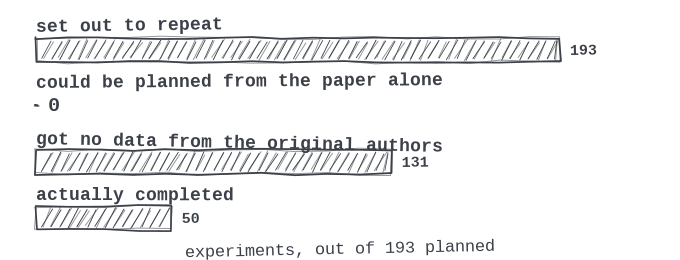
What happened to the 193 experiments, from[4].
Often the missing detail was small: when Vasilevsky and colleagues went through 238 papers to see whether the antibodies in them could be traced back to a specific product, fewer than half could be[5], for want of a catalogue number, a clone, or sometimes even a supplier. Anyone repeating one of those experiments would be guessing at their first reagent.
In 2012 a panel brought together by the US National Institute of Neurological Disorders and Stroke said the obvious thing out loud. Poor reporting, they wrote, “contributes to needless repetition of similar studies by investigators unaware of earlier efforts”[6].
All of that is published work, written with some care, for strangers. A lab notebook is written for the person holding the pen, on a day when every detail is still obvious, which is exactly why so many of the details never make it onto the page. That is the version the next person inherits.
So what does paying twice cost?
Nobody has counted it for a single lab, which is part of the problem. At the scale of a whole country there is one well-known estimate, and it comes with warnings attached.
Freedman, Cockburn and Simcoe estimated in 2015 that around USD 28 billion a year goes on preclinical research in the United States that cannot be reproduced[7]. It is a rough figure, built on the assumption that half of such work fails, and only part of the problem is lost records; poor reagents and weak study design take much of the blame. The same paper passes on an industry estimate that repeating an academic study before building on it takes three to twenty-four months and up to USD 2 million[7].
The number you can check is closer to home. The figures below are illustrative; put your own in.
| Cost line | How to estimate it | Illustrative |
|---|---|---|
| Scientist time | people x days x daily cost | 2 x 5 days x GBP 400 = GBP 4,000 |
| Reagents and consumables | from the original order | GBP 1,500 |
| Instrument or outsourced time | internal rate or CRO quote | GBP 1,000 |
| Delay | weeks lost x weekly spending | 3 weeks x GBP 15,000 = GBP 45,000 |
| Total | about GBP 51,500 |
One repeated experiment at an illustrative small UK biotech; the values are made up.
The direct costs are small next to the delay, and the delay line is the one people argue about. It only counts if the repeat sat on the path to something, a data package or a go or no-go decision, and plenty do not. If yours did not, cross it out and the bill is a few thousand pounds rather than fifty. If it did, remember that for a company not yet earning revenue, three weeks is three weeks of runway, and runway is what the last round was for. At the far end of the pipeline, one 2024 estimate puts a single day’s delay to a drug launch at several hundred thousand dollars in lost sales[8].
Who pays when a CRO repeats a study?
Inside a contract research organisation the same table reads differently, because the question is less how much than whose. On a fixed-price study the repeat comes straight out of the CRO’s margin. On time-and-materials work the sponsor pays, and a repeat that traces back to a method changed between pilot and main study, with no note of why, is the sort of thing raised at renewal. The regulated end of the industry does not leave this to chance: the UK regulator’s data integrity guidance expects raw data to “permit full reconstruction of the activities”[9]. Discovery work carries the same cost without the rule.
Not every repeat is waste
Replication is good science, and some repeats are run on purpose to see whether a result holds. The cost worth a name is narrower: the repeat that happened only because the earlier result, the exact conditions or the reason it failed could not be found or trusted.
Failed runs deserve a paragraph of their own, because they are where most of this cost hides. A run that did not work carries as much information as one that did, and sometimes more, since it tells the next person which door not to bother opening. It is also the record a lab is least likely to keep. Nobody writes up the Tuesday that went nowhere, and so somebody else lives through the same Tuesday a year later, at full price, convinced they are the first.
What is a found result worth?
The other side of the ledger is easier to like. Piwowar and Vision followed what happened to gene expression datasets after they were put into a public archive: for every hundred deposited, around forty papers had reused one within two years, and more than a hundred and fifty within five[10]. That is a public archive, not a notebook, but the mechanism is the same at any size. A result that can be found, understood and trusted is one that nobody has to pay for twice.
Price your own repeats
What should the records do instead?
I will not tell anyone how to keep a notebook; I have spent more time reading data rooms than filling one in. From the paying side, what I want is simple. When somebody asks for the data behind a slide, the answer should take an afternoon, not three weeks. The conditions should sit next to the result, the failures next to the successes, and the reason a method changed next to the change. And none of it should leave the building when the person who wrote it does.
It is the cost we think about most at Vantaria Labs.
Sources
- NZ IAS 38 Intangible Assets (New Zealand equivalent to IAS 38), paragraphs 54 and 57. External Reporting Board, New Zealand, date unknown. xrb.govt.nz/dmsdocument/839Checked
- Vines TH, Albert AYK, Andrew RL, et al. The availability of research data declines rapidly with article age. Current Biology 24(1):94-97, . doi.org/10.1016/j.cub.2013.11.014Checked
- Tedersoo L, Kungas R, Oras E, et al. Data sharing practices and data availability upon request differ across scientific disciplines. Scientific Data 8:192, . doi.org/10.1038/s41597-021-00981-0Checked
- Errington TM, Denis A, Perfito N, Iorns E, Nosek BA. Challenges for assessing replicability in preclinical cancer biology. eLife 10:e67995, . doi.org/10.7554/eLife.67995Checked
- Vasilevsky NA, Brush MH, Paddock H, et al. On the reproducibility of science: unique identification of research resources in the biomedical literature. PeerJ 1:e148, . doi.org/10.7717/peerj.148Checked
- Landis SC, Amara SG, Asadullah K, et al. A call for transparent reporting to optimize the predictive value of preclinical research. Nature 490:187-191, . doi.org/10.1038/nature11556Checked
- Freedman LP, Cockburn IM, Simcoe TS. The economics of reproducibility in preclinical research. PLoS Biology 13(6):e1002165, . doi.org/10.1371/journal.pbio.1002165Checked
- Smith ZP, DiMasi JA, Getz KA. New estimates on the cost of a delay day in drug development. Therapeutic Innovation and Regulatory Science 58(5):855-862, . doi.org/10.1007/s43441-024-00667-wChecked
- MHRA. GxP data integrity guidance and definitions, revision 1. Medicines and Healthcare products Regulatory Agency, . www.gov.uk/government/publications/guidance-on-gxp-data-integrityChecked
- Piwowar HA, Vision TJ. Data reuse and the open data citation advantage. PeerJ 1:e175, . doi.org/10.7717/peerj.175Checked
Change log
- Published.
Related notes
Vantaria is in early access, and we are working with a small number of labs as we build it. If yours would like to be one of them, request a demo.